

By Peter Quaqua

The question is not whether Liberia needs a law to combat cybercrime. It does. The question is what happens when a law designed to protect citizens online also gives the State unrestrained powers over what people can say, publish and share? At what point does protecting the public from cybercrime begin to encroach on the freedom of expression that the Constitution protects?
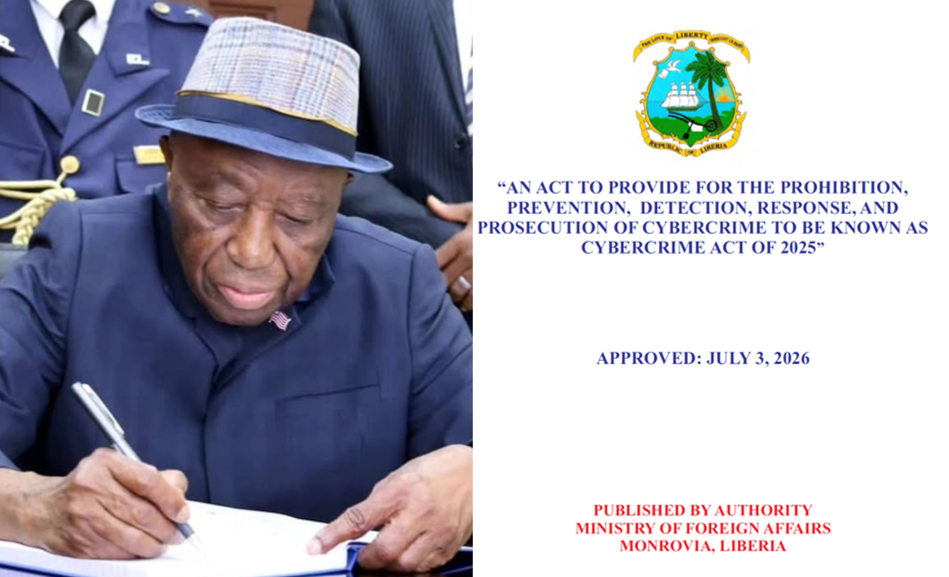
That is the concern surrounding Liberia’s Cybercrime Act of 2025, which seeks to address hacking, fraud, identity theft, online exploitation, genuine threats and other forms of digital abuse.
Several provisions of the Act raise serious questions about freedom of expression, privacy and due process. In practice, this instrument could become a tool for re-criminalizing speech that Liberia has already chosen to protect.
Liberia’s recent history.
The Kamara Abdullah Kamara (KAK) Act of Press Freedom, enacted in 2019, repealed criminal libel against the President, sedition and criminal malevolence. It marked an important step away from using criminal law to punish certain forms of expression.
Liberia should therefore be careful not to repeal speech offenses in one law only to recreate substantially similar offenses through another simply because the speech takes place online.
A speech offense does not become less of a speech offense because it is transmitted electronically.
Where the concern lies
The provisions that deserve the closest attention include Sections 15, 17 and 19, dealing respectively with cyberstalking, racist and xenophobic offenses, and the distribution of harmful data messages. Sections 28 and 29, concerning searches and interception, also raise important questions about privacy and press freedom.
The issue is not whether genuinely harmful conduct should be punished. The real question is whether some of these provisions are drafted so broadly that legitimate criticism, journalism, political commentary, advocacy—or even an honest mistake—could become a criminal offense.
That distinction matters.
Section 19, concerning the distribution of harmful data messages, deserves particular scrutiny. It criminalizes the intentional distribution of a “harmful” data message and includes concepts such as information that is “inherently false” and intended to cause mental, psychological, physical or economic harm. It also uses a reasonable-person standard and provides for a possible prison sentence of up to three years. This raises difficult questions.
People can be wrong without being criminals. They can say something offensive without committing a crime. They can criticize public officials harshly without crossing the line into criminal conduct. Investigative journalism can expose wrongdoing and cause reputational or economic consequences without itself being unlawful.
The broadly worded provision could potentially reach investigative reporting, allegations of wrongdoing, whistleblowing, political commentary, satire and social-media commentary—forms of expression that are central to public debate.
The concern is greater where there are no clear safeguards for truth, reasonable mistake, public interest, opinion, satire, fair comment and legitimate journalism. There is a fundamental difference between deliberately making a genuine threat and publishing something that another person considers false, offensive or damaging. The difference is important.
Cyberstalking and the meaning of harassment
Section 15 criminalizes transmitting computer data with the intent to “bully, threaten or harass” another person where the communication places that person in fear of death, violence or bodily injury. Protecting people from genuine threats and targeted intimidation is a legitimate function of the law.
The difficulty is making sure that words such as “bully” and “harassment” are not interpreted so broadly that they capture persistent criticism, investigative reporting, aggressive political commentary, online advocacy or sustained questioning of public officials.
A citizen who repeatedly criticizes a public official is not necessarily a cybercriminal. An activist conducting an online campaign is not necessarily a cybercriminal.
The law must distinguish between protected expression and genuine intimidation or threats. That distinction becomes especially important when those in positions of authority are the subjects of criticism.
Section 17: Insult is not the same as incitement
There is a legitimate basis for restricting racial, ethnic or religious incitement, particularly where expression advocates discrimination, hostility or violence. But an offensive or insulting statement is not automatically the same thing as incitement.
Freedom of expression protects not only popular and comfortable speech, but also unpopular, uncomfortable and sometimes provocative speech. Restrictions should target genuinely harmful conduct rather than give authorities broad discretion to determine which opinions are acceptable.
Memories are still fresh of the case in which Julie Endi sued “Prophet Key” for allegedly insulting her online. It took the intervention of the Legal Adviser to the President of Liberia to have the matter dismissed, reportedly in the interest of upholding the “Table Mountain Declaration” and the Abdulai A. Kamara Act of Press Freedom. Wasn’t the court qualified to determine whether the matter was cognizable under the law?
Yet the Legal Adviser was not heard when the same individual, Prophet Key, was summoned by the full machinery of the Supreme Court after he allegedly insulted the mother of the Chief Justice. He was brought before the full bench and eventually sentenced to six months in prison.
Whatever the circumstances of the two cases, the contrast raises a fundamental question: what lesson did the public learn from those two duty bearers? Is it fair to suggest that the application of the law depends on who is involved?
That is precisely why laws dealing with speech must be clear. The more discretion the law gives authorities, the greater the need for safeguards against selective application.
Liberia has already taken important steps away from criminalizing speech. The challenge now is to ensure that those gains are not quietly reversed through legislation.
Searches, interception and the right to communicate privately
The provisions on searches and interception have privacy implications. Think for a moment. Section 28 permits investigative or search measures without a warrant in circumstances described as involving “verifiable urgency,” while Section 29 permits interception of electronic communications under specified circumstances, including an urgent mechanism involving ministerial authorization followed by judicial review. Doesn’t this sound like state surveillance?
These powers may serve legitimate law-enforcement purposes. But they require strong safeguards.
Make no mistake. Journalists should be able to protect confidential sources. A whistleblower should be able to communicate with a journalist. A lawyer should be able to communicate confidentially with a client. An activist should be able to organize without assuming that legitimate communications will automatically become subject to state surveillance.
The issue, therefore, is not whether interception can ever be lawful. It is whether the safeguards are sufficiently clear, necessary, proportionate and subject to meaningful judicial oversight.
Without such protections, powers created to fight cybercrime can have a chilling effect far beyond the criminals they are intended to target.
Why Constitution Matters
These questions cannot be separated from Liberia’s constitutional framework. Article 15 of the Liberian Constitution protects freedom of expression, freedom of speech and press, and the right to receive and impart information. It also recognizes the public’s right to be informed about government and its functionaries.
That protection belongs to everyone: journalists, students, activists, civil servants, politicians, religious leaders, bloggers and ordinary citizens using Facebook, WhatsApp, YouTube or other digital platforms.
The fact that speech is delivered electronically does not automatically remove its constitutional protection.
The same principle is reflected in Article 19 of the ICCPR, Article 19 of the Universal Declaration of Human Rights and Article 9 of the African Charter. International standards generally require restrictions on expression to pursue a legitimate purpose and to be necessary and proportionate.
The African Commission on Human and Peoples’ Rights has likewise recognized that freedom of expression applies to new information and communication technologies. Its standards emphasize that restrictions must be provided by law, serve a legitimate interest and be necessary in a democratic society.
Cybersecurity and freedom of expression can coexist
It should be said, that defending freedom of expression does not mean defending fraud, identity theft, genuine threats, harassment, incitement or other criminal conduct.
The State can prosecute fraud without criminalizing opinion. It can punish a genuine threat without criminalizing criticism. It can address incitement to violence without criminalizing disagreement. It can protect people from targeted abuse without creating a general offense based simply on being offensive.
Liberia does not have to choose between cybersecurity and freedom of expression. It can protect both. But doing so requires laws precise enough to distinguish criminal conduct from protected expression, safeguards that prevent abuse of investigative powers, and institutions willing to apply the law consistently—regardless of who is speaking, who is being criticized or who is offended.
The Cybercrime Act should therefore protect Liberians from cybercrime. However, it should not become a backdoor for criminalizing expression that Liberia has already chosen to protect. And that is why the question posed by this law is worth asking plainly:
Is Liberia building a law to protect its citizens in the digital age—or creating a decree in disguise?”
ABOUT THE AUTHOR: Peter Quaqua is a former president of the Press Union of Liberia (PUL), the West African Journalists Association, a media rights advocate and champion of Free Expression.
