

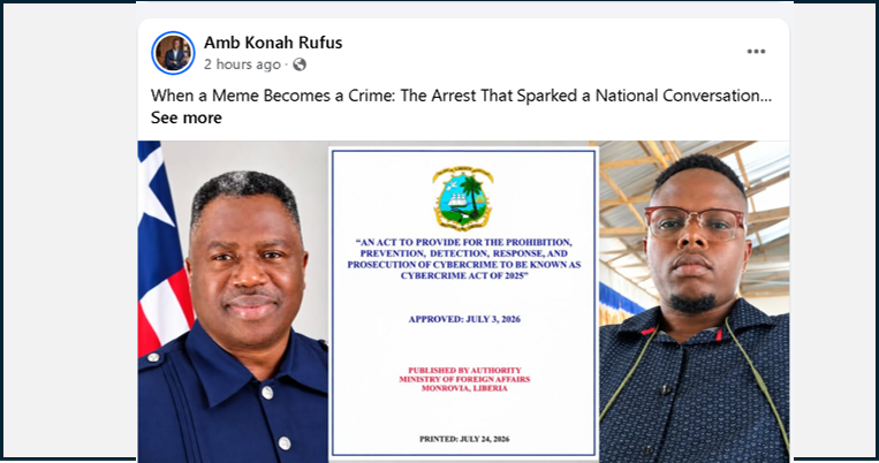
–The Arrest That Sparked a National Conversation
By Konah Rufus
What began as a social media controversy has rapidly transformed into one of Liberia’s most consequential debates on free expression, state power, and the limits of cybercrime enforcement.
At the center of the storm is Jerry Nyantee Wratto, a young Liberian accused of creating and circulating artificial intelligence-generated images depicting Vice President Jeremiah Koung. His arrest under Liberia’s Cybercrime Law, subsequent transfer to Monrovia, and eventual release by direct intervention of the Vice President have triggered a national conversation extending far beyond one individual case.
For many Liberians, the issue is no longer about Wratto alone. It has become a question of whether criticism, satire, or ridicule of public officials should ever lead to criminal prosecution in a democratic society. The arrest immediately drew public attention, but concerns intensified when veteran journalist and Chief Executive Officer of Blaze Communication Network, Gibson W. Jerue, publicly questioned the circumstances surrounding Wratto’s detention and raised allegations regarding his treatment while in police custody.
In a social media post made while Wratto remained in detention, Jerue described him as a “political prisoner” and alleged that police officers subjected him to intimidation, psychological pressure, and harsh treatment. Jerue claimed that sources close to the matter informed him that Wratto was prevented from eating during his transfer to Monrovia and that family members alleged he was denied access to food and contact with relatives. He further alleged that police officers attempted to obtain information from Wratto without a lawyer present and before his rights were properly explained to him. Jerue also claimed that family members were prevented from seeing Wratto after he arrived at the Liberia National Police headquarters on Capitol By-Pass.
The journalist additionally raised concerns about the length of Wratto’s detention, arguing that constitutional protections regarding detention without charge should be observed. Jerue’s allegations generated significant discussion on social media and among civil society actors, although the Liberia National Police had not publicly responded to those specific claims at the time the debate intensified.
Those allegations shifted public focus from the content what led to the arrest to the methods used in enforcing the law. Social media discussions, radio talk shows, and political commentators began debating whether the state’s response was proportionate and whether the Cybercrime Law could potentially be used to suppress expression critical of public officials.
The debate took a dramatic turn on September 19, 2026, when Vice President Koung publicly intervened. After contacting the Inspector General of Police and confirming that Wratto had been arrested under the Cybercrime Law, the Vice President announced that he did not wish to pursue charges against the young man. He subsequently ordered Wratto’s immediate release.
In his statement, Koung acknowledged a reality familiar to public officials around the world: leadership often attracts criticism, ridicule, and deliberate provocation. More importantly, he suggested that tolerance and restraint are essential qualities of public service. His decision earned praise from some quarters, but it also prompted a more troubling question from others: if the Vice President did not want charges pursued, why was Wratto arrested and jailed in the first place?
That question was echoed by former Finance Minister Samuel D. Tweah Jr., whose reaction added a powerful political dimension to the controversy. While thanking the Vice President for securing Wratto’s release, Tweah argued that the intervention addressed the symptom rather than the problem.
“That you have to call for his release is the problem,” Tweah stated. “He should not be behind bars for free speech in the first place.”
The former minister went further, criticizing Liberia’s cyberbullying legislation and arguing that it contradicts the country’s democratic trajectory. He pointed to Liberia’s endorsement of the Table Mountain Declaration during the administration of former President Ellen Johnson Sirleaf and the passage of the Kamara Abdullah Kamara Act under former President George Weah as milestones that strengthened press freedom and free expression.
For Tweah and others who share his concerns, the Wratto case represents a crossroads. They argue that public officials must accept criticism as part of democratic life and that criminal penalties should not be used to shield leaders from public scrutiny. Supporters of stronger cybercrime enforcement, however, maintain that digital platforms can be used to spread harmful content, misinformation, and targeted attacks that require legal safeguards.
The competing viewpoints have exposed the difficult balance modern democracies face in the digital age. Governments seek to protect citizens from online abuse and harmful digital conduct, while civil liberty advocates warn against laws that could chill legitimate expression. Liberia now finds itself confronting that same dilemma.
What remains undeniable is that a case that started with AI-generated social media content has evolved into something much larger. It has become a national reflection on freedom, accountability, and the relationship between citizens and those who govern them.
As the public debate continues, the name Jerry Nyantee Wratto may come to symbolize more than a single arrest. It may represent a defining moment in Liberia’s ongoing struggle to determine how far the state should go in regulating online speech and how much criticism democratic leaders should be expected to endure.
In the end, the controversy poses a question that reaches beyond one law, one arrest, or even one Vice President: In an era where technology is reshaping public discourse, how can Liberia protect both the dignity of individuals and the fundamental right of its citizens to speak freely?
ABOUT THE AUTHOR: Konah Rufus, aka Ambassador Konah Rufus, is the Acting News Editor of Blaze Radio 90.7FM news department. He is socio-economic and political commentator and analyst, and a emerging prolific writer of a decent taste.
